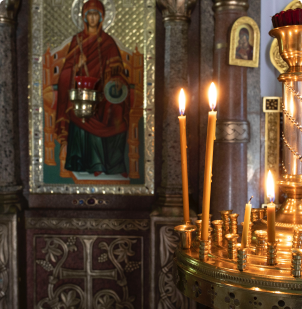
In the eighth century, during the iconoclastic movement, Saint John of Damascus (+c. 780; comm. 4 December) was slandered before the Caliph of Damascus by the Emperor Leo III Isaurius (717-740) for his zealous veneration of holy icons. The caliph ordered the saint’s hand to be cut off and hung in the market. In the evening of that day, Saint John, having asked the caliph for a severed hand, applied it to the joint and prostrated himself before the icon of the Mother of God. He prayed to the Most Pure to heal the hand that defended Orthodoxy. In a dream, the saint saw how the Most Holy One promised him a speedy healing and instructed him to work diligently with this hand. When the saint awoke, he found that his arm had become healthy. As a sign of gratitude for the healing, he placed a silver hand on the icon, and it became known as the “Three-handed Icon”. St. John of Damascus became a monk in the Monastery of St. Sava the Consecrated and gave the miraculous icon there. The Lavra presented the icon of the “Three-Handed Woman” to St. Sava, Archbishop of Serbia (+1237; January 12). During the Turkish invasion of Serbia, Christians handed over the icon of the Mother of God for its protection. They put her on a donkey, which, without a driver, came to Mount Athos and stopped in front of the Hilandar monastery. The monks placed the icon in the cathedral church. When there were disagreements over the choice of abbot, the Mother of God herself took over the abbacy, and her holy icon took its place in the church. Since then, only the vicar is elected in the Hilendar monastery, and the monks, according to monastic custom, receive a blessing from the holy icon for all obediences. One of the 17th-century Troeruchitsa icons is the main relic of the Troyan Monastery in Bulgaria. In Russia, the icon of “Troeruchitsy” enjoys special veneration. In 1661, a copy of this icon was brought from the Hilandar Monastery for Patriarch Nikon for his New Jerusalem monastery, delivered to Moscow on June 28 (July 11, New style). At this time, the second feast of the icon’s memory was established in honor of its appearance on Moscow land. The Church of the Assumption of the Blessed Virgin Mary in Gonchari (Bulgarian Metochion) keeps a list of this icon, which is associated with the preservation of the church and its bells even in times of persecution of the faith. Every Friday, an akathist is read in front of this icon. On the western wall of the church there is another list, and prayers are often heard in front of the icon of the “Troeruchitsa”. Nevertheless, the representation on the icons of the Virgin with a third hand, as if it were her own, caused natural embarrassment. In this regard, the Holy Synod, by decree of May 21, 1722, banned the depiction of such icons, since they contradicted nature, history and truth.
Order sacrifices
in temples and churches online
in temples and churches online