Celebration: March 19
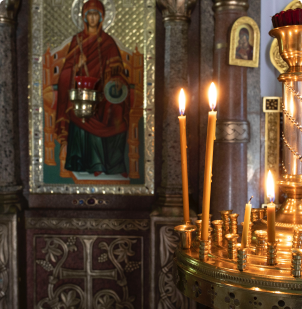
In Moscow’s Archangel Cathedral, located in the Kremlin, among the sacred icons on the left side of the tsar’s gate hides a miraculous icon of the Mother of God, called “The Blessed Sky”. The beautiful image of the Most Holy Theotokos holding the Eternal Child in her arms radiates her grace and is surrounded by a bright red mandorla, from which luminous rays emanate. This image is also known as ” What shall We call Thee?”, a title taken from the text of the Virgin of the 1st Hour, inscribed along the shining mandorla: “What shall We call Thee, O Blessed One? Heaven, for thou didst shine forth the Sun of Truth; paradise, for thou didst vegetate the Flower of incorruption; The Virgin, for thou didst remain incorruptible; The pure Mother, for thou didst have in Thy holy arms the Son, God of all. On this icon of the Most Holy Theotokos, under her feet was originally depicted a monthly sickle, which corresponds to the description in the Revelation of John the Theologian:” And a great sign appeared in heaven: a woman clothed with the sun, with the moon under her feet, and on her head a crown of twelve stars… And she gave birth to a child. she gave birth to a male child, who is to rule all nations with a rod of iron; and her child was caught up to God and to His throne.” 12:1,5). There is a legend that this image was previously located in Smolensk and was transported to Moscow in the XIV century by the daughter of the Lithuanian Prince Vytautas, Sofia, after her marriage to the Moscow Prince Vasily Dmitrievich (1389-1425). Together with many other ancient icons brought from Constantinople (according to the records in the Trinity Chronicle for 1398). This information became known in 1853, when the iconostasis of the Archangel Cathedral was restored, and Metropolitan Philaret (Drozdov) gave instructions to collect historical information about the miraculous image. In the 17th century, the inventory of the Archangel Cathedral indicated that the image was created as a copy of an ancient icon that was located in the cathedral, by decree of Tsar Theodore Alekseevich. The icon “Blessed Heaven”, which is now located in the iconostasis of the Archangel Cathedral, was created by icon painters during the creation of the new iconostasis in 1678-1680 and installed in a silver salary with the text “Theotokos”. The old salary was stolen in 1812, and was replaced with a new one in 1815. In 1916, the icon was decorated with a silver vestment and false silver cherubs on the margins, but they have not survived to this day. The original image, which appeared in Germany in the fifteenth century and quickly became popular in Western art, traveling through Ukraine, Belarus and Lithuania to Russia in the XVII century. At the beginning of the XX century, Saint John of Kronstadt blessed the creation of a copy of this icon “Blessed Heaven” for the sacristy of the Vaulovsky Assumption Skete in the Yaroslavl province. Currently, it is located in the Resurrection Cathedral of Tutaev in the Yaroslavl region. Another copy of this miraculous icon was placed in the Church of the Crucifixion of Christ in the Grand Kremlin Palace. In the late 19th and early 20th centuries, this icon was celebrated twice a year: on March 6 and on All Saints ‘ Week. On Fridays, after the Liturgy, a moleben was held in front of the icon with an akathist and water blessing. The “Blessed Sky” icon represents a great shrine and a beautiful symbolic image of the Most Holy Theotokos, who nurtures our Savior, and the mandorla and shining rays symbolize the divine glow and grace emanating from her. This image confirms her special connection to the heavenly powers and her enduring role in the Christian faith. This miraculous icon has ancient roots, and its history shows how faith and reverence for the Mother of God are transmitted through generations. She traveled through the ages and countries, preserving her blessing and greatness. The Holy Sky icon is honored and honored by the faithful not only in the Moscow Archangel Cathedral, but also in other churches and monasteries. Her bright image and power inspire the prayer and faith of believers, and her miraculous gifts bring comfort and healing. For many years, it has been and remains one of the greatest symbols of faith and grace associated with the Russian Orthodox Church, and its history reminds us of the importance of eternal values and the power of faith in our modern times.